
Foulen
To be Foulen is to work one strip of somebody else's country alone for a hundred and forty years, and to be liked in the tavern the whole time.
Something is standing at the end of the wood, where the trees stop and the field wall begins, and it has been standing there for a hundred and forty years. Five to six feet of narrow bone under a rust-red coat, fox-headed and two-legged, with a brush of a tail as long as the body and a laugh at night that sounds close enough to a person to bring somebody to a window. The Foulen work one strip of somebody else's country, alone, for a whole lifetime, and they drink in that country's taverns every night of it.
They were made late, out of stolen Fould, and they were made for a job the Alverians did not want fought. The frontier works needed certain edge settlements emptied, and the method was not battle. It was the eggs, then the lambs, then the child, and then the will of the place. Light, quiet, clever with a latch, small enough to go under a fence and shaped enough to be let in at a door. The empire that ordered the work fell before the work ran out, and nobody stood them down.
What was taken out of them somewhere along the way was the horn. The Fould hear Irus, answer him, and run the fold as a pack. The Foulen perform the same rite, alone, at the same hour, correctly in every part, every season for a hundred and forty years, and nothing answers. They have no society to speak of and no history since the fall, only a range, a den full of sorted spoons, two nights a year on which they stand in a circle facing outward and are elaborately courteous to one another, and a good coat at the bar.
Origin
Fox-headed, two-legged, digitigrade and alone. Five to six feet of narrow bone under a rust-red coat, with a brush of a tail as long as the body, moving along the last fifty yards of woodland before somebody's fields begin. The Foulen are the line of the Fould that stopped answering the horn, kept the standing form, and turned the hunt inward on the villages at the forest edge, and they have been working that edge ever since.
The splice is Nu'uman, Fould and fox, on the Gidan precedent, which is the one case of an Irugaine variant being used as a component. The parent stock is the Fould, the Greener Fold Hounds, an Irugaine variant, lion-wolf in build with a grass pelt. The Fould answer Irus to the hunt and run the fold as a pack, taking four legs in public and two in private. The Foulen are the line that stopped answering. They kept the two-legged form permanently, went solitary, and turned the hunt inward on the villages at the forest edge. The Irugaine do not claim them. The Fould will not run with them.
The making is recent by the standards of the record. The Alverians took Fould from a fold on some hot forest margin, put the fox into them and the Nu'uman over the top of it, and made a thing that could work a settlement rather than a wood: light, quiet, clever with a latch, small enough to go under a fence and shaped enough to be let in at a door. The stated purpose was the clearance of edge settlements that the frontier works needed emptied, and the method was not battle. It was a season of losses. Livestock, then children, then the will of the place.
The Unanswering. The Fould hear Irus. The horn goes up over the fold and the whole fold answers it, and this is not obedience but the way that people is built. The Foulen do not hear it. Whether the makers cut the hearing out, or whether Irus stopped calling to a thing that had been made to hunt villages, is the oldest argument at the forest edge, and the Irugaine will not discuss it, and Irus has not said. What the Foulen themselves hold, and hold with a chip on the shoulder that is audible at a hundred yards, is that they answered for a long time and were not answered back.
After the collapse they scattered along every wooded margin they could reach and have never gathered since. There is no Foulen history after the fall, because a history needs somebody to keep it together, and the Foulen went to ground one at a time.
Body
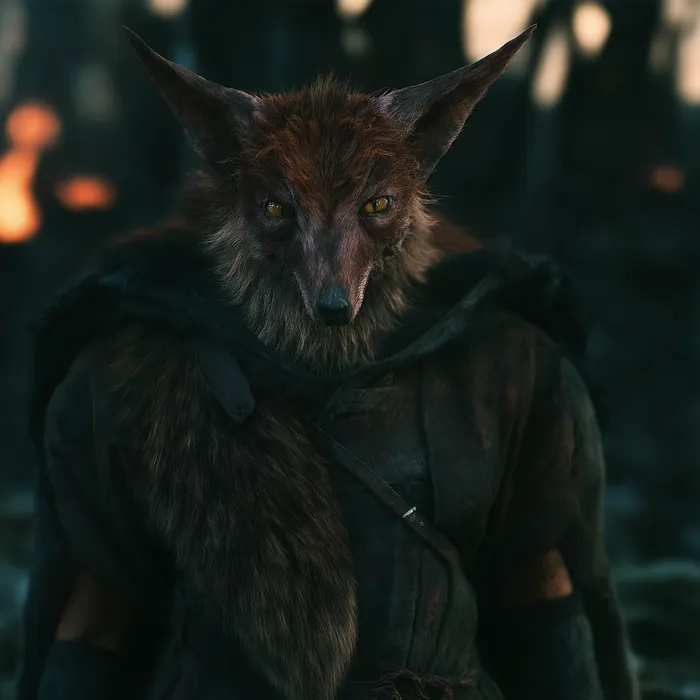
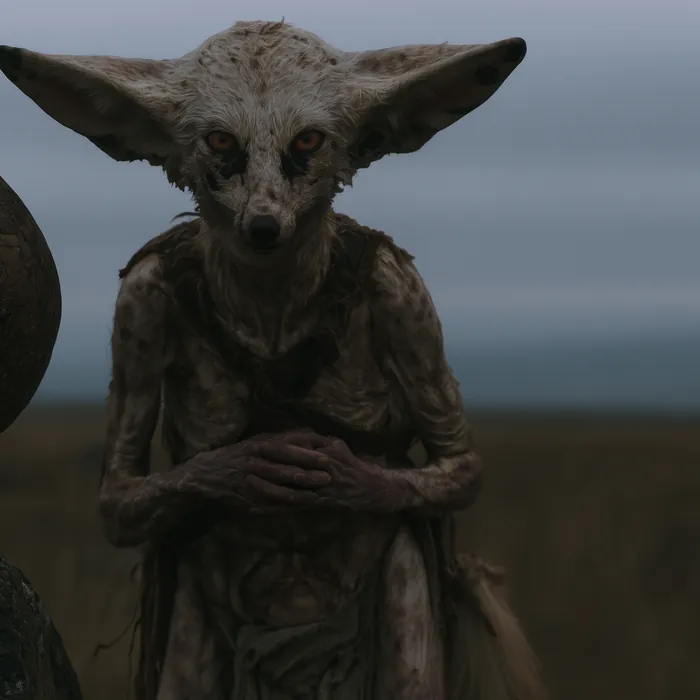
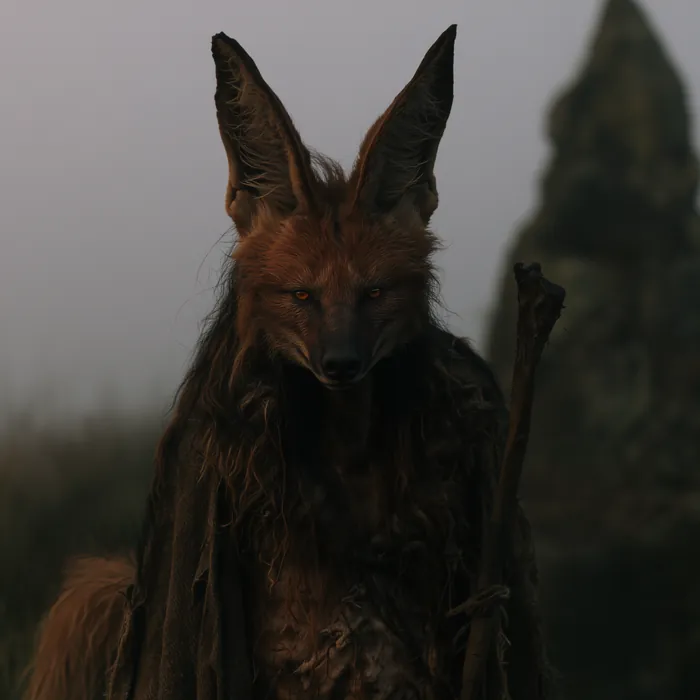
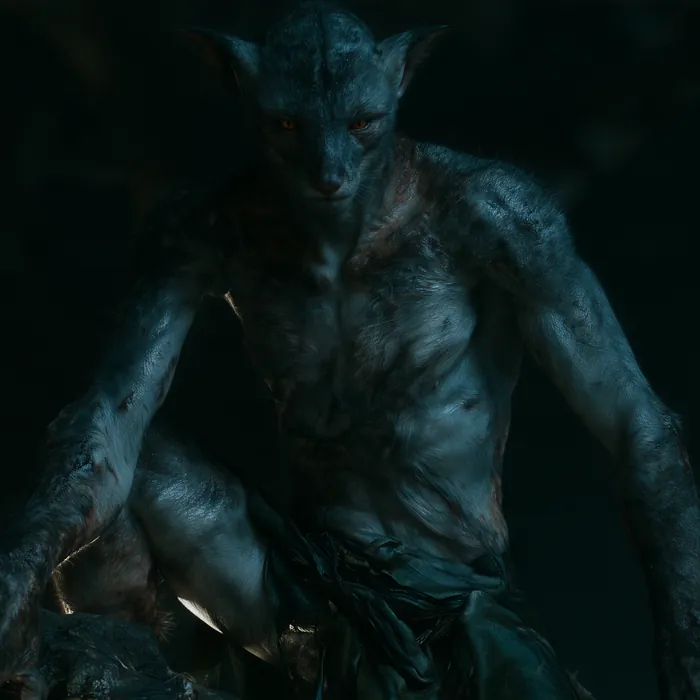
Lean, narrow-framed and light through the bone, standing five to six feet. The head is sharply tapered to a long slender snout, far finer than the Fould's heavy hound skull. Large triangular ears set high and forward, mobile, turning independently. Eyes amber-gold with a vertically slit pupil, unusual among the canid kin. Rust-red fur runs dense over the back and shoulders, fading to cream at the throat, belly and jaw, with black stockings marking each forearm and shin. The tail, the brush, is thick and near as long as the torso, carried low when calm and horizontal when hunting. Digitigrade stance, unlike the plantigrade Lathonian, which raises the heel and lengthens the leg. The hands are narrow with five fingers and short non-retractable claws, better suited to opening and stealing than to killing.
Weight runs ninety to a hundred and fifty pounds, very light for the height, and it is the first thing anyone who has wrestled one remarks on. They are hollow-feeling and hard to hold. The voice is high and clear and carries, and the laugh is the thing villages describe when they describe them, since a Foulen laughing at night sounds close to a person and is not.
They are the only digitigrade people in the record and everything about their lives comes out of it. The heel rides high off the ground and the foot is a third limb segment, so the leg is a long spring with a heavy tendon down the back of it: forty yards from a standing start faster than anything that hunts them, and nothing after that. A Foulen sprint is one breath long and it is paid for over the next ten minutes, bent over, sides going. They cannot march, cannot carry, cannot stand still in comfort, and shift their weight constantly, which reads as nerves and is architecture. They cannot fight a standing fight and never try one: every act of Foulen violence in the world is an ambush from behind or a flight, and this is why a Foulen who wants numbers has to buy them.
The same leg makes them silent. The pads come down first and there is no heel-fall, so a Foulen crosses a plank floor above a sleeping household and the household sleeps, and a Foulen on a gravel path can be heard only by another Foulen. No boot made for any other people fits them. They cut boots open at the heel or go barefoot, and a cut boot in a market is worth reporting to the county.
Their world is dusk. The slit pupil opens to a full round black in low light over a mirrored layer, and they see at a quarter of a moon as well as a Nu'uman sees at noon, in greys and golds with almost no red in them, which is the joke of a rust-coloured people who cannot see their own colour. Daylight closes the pupil to a hair and they squint through it and dislike it. What they have instead of sight is the low hearing: a hen shifting on a perch through a shut door, a mouse under four inches of snow, a bolt being drawn two rooms away, the difference between a dog asleep and a dog pretending. Smell is the third sense and is mostly used for who has been here and when.
They also hold a bearing. A Foulen pouncing on something it can hear and cannot see always jumps along the same line, the same alignment, every time, and cannot say why and does not find the question interesting. Brush-marks are cut on that bearing so that another Foulen can find them in the dark by standing right and looking along, which means the whole signalling system of the species is oriented to a sense none of them can describe.
Life
They breed in the cold months and they do it briskly and without ceremony, since two Foulen in one place is already unusual and neither intends it to last. A litter is two to five kits, born blind in a stopped-up den under a root ball or under a barn floor. The mother rears them alone and rears them well, and the six months of the kit-den is the only period in a Foulen life with any warmth in it, and every Foulen remembers it and none of them will say so.
The Turning Out comes at eleven months. The mother takes the litter to the edge of somebody else's ground, gives each kit one worked object out of her own kit, and goes, and does not look back, and does not answer if they follow. A Foulen who is still with its mother at a year is a scandal. The object is kept for life and is called the mother-thing, and it is the one item a Foulen will die over, and it is usually a spoon.
After that, alone. A Foulen keeps a range rather than a home, four to nine miles of woodland margin with three or four dens in it, and works the villages inside it. Two Foulen ranges may overlap and the occupants will avoid each other for decades with real skill. They meet twice a year, at the two Nights, and otherwise not at all.
They are omnivores that lean hard to meat: poultry, lamb, hare, eggs, fish out of a weir, fruit, roots, and whatever is on a windowsill. The gut is a scavenger's and will take meat three days gone without complaint, which is a solitary hunter's insurance and is also why a Foulen will eat a thing it has cached and forgotten and be perfectly well the next morning. Nothing is hunted honestly if it can be taken instead, and the taking is the pleasure.
Caching is the deep habit and it has nowhere to go. A solitary hunter buries surplus against a bad week, and a people who steal small metal instead of killing large animals are left with the instinct running on objects: spoons, buckles, keys, rings, hinges, thimbles, buttons cut off coats. A Foulen den holds an astonishing quantity of it, sorted, and the sorting matters to them enormously and cannot be explained by them, and the one reliable way to reduce a captured Foulen to genuine distress is to disturb the arrangement.
Death is usually violent and usually a farmer. A Foulen who reaches old age goes into the deep wood, digs a last den, and stops coming out, and their own custom is to leave the den unopened and unmarked.
Frailty
The brush is a balance organ before it is heraldry. A Foulen turning at speed throws the brush against the turn, and without it the turn is a fall. A docked brush therefore ends the running and ends the hunting, and a Foulen with a cut tail is dead of a dog or a bounty man inside a year, whatever anyone's opinion of the punishment. This is why cutting one is a killing matter, and it is why the punishment their own people use is the same act.
The leg that makes them fast wears out. The hock and the long tendon go in the seventies, the spring stops returning, and an old Foulen walks flat-footed and is finished as a thief. Most of them turn to the taverns at that point: information, receiving, guiding, lending, and the running of a thin pack, which is a job that can be done sitting down. A Foulen boss is almost always a Foulen who can no longer run.
They lose the low hearing before the eyes, and starve. Mange takes the young of a bad winter and strips the coat and with it the one thing they own that is worth money. And the bounty is a disease of the species as surely as anything in the blood: several counties pay on the brush, the payment has outlived every official who set it, and more Foulen die of a standing line item in a county ledger than of anything else.
The splice shows its seam in the ears and the jaw. Kits are born every few litters with the Fould's heavy skull on the fox's light frame, and the head is too much for the neck, and they do not thrive and do not live past the Turning Out. The mothers know at a fortnight, and turn those kits out early, and the villages find them, and the villages assume a beaten child.
Country
The Verge. Not a country and not a claim: the whole band of ground, anywhere in the world, where the trees stop and somebody's fields start. The Foulen live in that band and nowhere else. They will not go deep into forest, which belongs to the Fould and to the Irugaine and is dangerous to them, and they will not live inside a town, though they visit constantly and drink in the taverns and gamble and are served.
A Foulen dwelling is a den or a stolen structure: an abandoned mill, a hayloft, a shrine nobody visits, the crawlspace under an inn. They furnish these with an astonishing quantity of small stolen goods, arranged.
A worked verge shows it. The hedgerow game goes first and the ground-nesting birds go with it, so the insects come up and the crops behind the hedge do better for a decade and then worse. The villages answer with dogs, and the number of dogs on a wooded road is the surest measure of how long the Foulen have been there. Where a range has been held for fifty years the field edge is pulled back forty yards from the trees, the hedges are grubbed out, the orchards are walled, and the shape of the farmland itself has been redrawn by one person nobody has ever caught. When a Foulen dies and the range stands empty, the hedges come back within a generation and the next Foulen who finds it thinks well of the previous tenant.
Society
There is no Foulen society, which is the point of them, and there are three exceptions to that, which are the whole of their culture.
The two Nights. Twice a year, at the turn of the cold and the turn of the warm, every Foulen within reach of a chosen place comes to it, and they hold a night of it: trade in stolen goods, settling of range boundaries, breeding arrangements, and news. It is conducted with elaborate courtesy, everyone stands facing outward, nobody sits, and it breaks up before dawn. Anything unresolved at dawn is resolved by whoever is faster. A Foulen who misses three Nights running is presumed dead and their range is auctioned.
The thin pack. A Foulen who wants a pack cannot have one, since no other Foulen will run with them, and so those who need numbers buy them: bought muscle, bonded debtors, Gorklin taken out of the Wilder lands, Imps, the desperate of any people. A thin pack is held together with money, food and fear, and it is the only form of Foulen leadership there is. The bell is the instrument of it. A Foulen who runs a thin pack wears a collar of polished metal hung with a bell, and the bell does what the horn does for a Fould and the howl does for a Foulgahr. The pack is trained to it from the first day, and a boss will ring it in a crowded market for no reason, to watch the pack twitch, and to watch the market watch.
The taverns. Canine patrons of the wooded margin drink in the taverns of every forest-edge district as ordinary custom, sat among Amphirien gamblers and Dugril and everyone else, and this is the exception that matters most for the world as it is. The Foulen are not creatures of a wilderness that the towns never see. They are in the towns every night, drinking, dicing, listening, buying, and going back out to the Verge before light. A Foulen in a tavern is charming, generous with other people's money, an excellent liar and the best source of information in the district, and every innkeeper on a wooded road knows exactly what is sitting at the end of the bench.
Dress is what has been taken and altered to fit: good coats worn to ruin, boots cut open for the digitigrade foot or no boots at all, and a great deal of small metal. They will not wear anything over the ears and they will not wear anything that covers the brush. Food is stolen food and tastes better for it. Drink is anything. The music is whistling, which they do constantly and unconsciously, and which is how they are tracked when they are tracked. An oath is sworn on the brush, held in the swearer's own hand, and it is kept, which surprises everyone once.
The brush is the motif of the species and its whole heraldry. It is groomed obsessively, oiled, sometimes dyed at the tip, hung with rings and with small stolen objects. It is carried low in company and level when working, and the carriage of a stranger's brush is read across a room before the face is. It is bad manners to stand behind a Foulen. It is a challenge to touch the brush and a killing matter to cut it, and a Foulen with a docked brush is either a criminal among their own or a slave, and in either case is finished.
The taboo list is short and absolute: do not cut a brush; do not open a last den; do not take another Foulen's mother-thing; do not answer a horn.
Faith
The Silent Horn. They keep Irus, and they keep him in the hunter's half only. The shepherd face of the god, the one who keeps and folds and protects, is held in open contempt, and the contempt is loud and is aimed at the Fould as much as at the god. The hunter face is honoured with the full old rite of the fold, done alone: the standing at the edge at dusk, the listening, the first blood put on the ground, the taking. Every part of it is performed correctly. Nothing answers.
The doctrine is that the horn still sounds and they have been cut off from hearing it, and that the fault is not theirs, and that the hunt is owed to them. A Foulen at the rite waits, every time, for the answer, and does not get it, and does the rite again the next season. It is a hundred and forty years of that per lifetime.
There is a minority who say something else answers. They are found mostly among the Foulab and mostly in the wake of armies, and what they say is that the listening was heard by one of the Princes, and that the price is the villages, and that it was always the villages. The Irugaine, who fear Irus in constant certainty that the gods exist, regard this as the single most dangerous idea currently loose at the forest edge, and it is one of the reasons they will not claim the Foulen.
Irus has no realm. Whatever a Foulen expects at the end, the soul goes to the auction of the star gods with every other soul on Nu, and the horn is not there either.
Tongue
Common, spoken beautifully. The Fould's own tongue, the bark-cant of the fold, survives in them as an accent and about two hundred words, most of them to do with ground, scent and warning, and a Foulen who uses bark-cant to a Fould is not answered.
Their own communication is brush-marks: scratches, hung objects and scent set on gate-posts, stiles and bridge-rails along a range boundary, cut on the jumping bearing so that another Foulen standing right will see them in the dark. The vocabulary is small and precise. This range is held. This house is emptied. This dog is a problem. This one pays. A traveller who learns to read brush-marks learns which villages on a road are already being worked, and there are people who sell that reading.
A Foulen carries one given name, short and sharp, chosen by the mother in the den, plus whatever the villages have decided to call them, and the village name is the one that lasts. Eight names: Argath, Ressik, Vann the Latch, Ohmi Redglove, Skell (no relation to the Baruush house, and the coincidence is enjoyed), Tarrow Sixdogs, Meska, Old Whistle.
Regard
The old tales and the common tongue call them Maemmalies, and also Maemmalie and Maemmalises, and those people are these people. Maemmalie is the outsiders' word, a folk term for the canine peoples of the wooded margin, and the three spellings in circulation are three districts' pronunciation of it. Foulen is what they call themselves, and they use Maemmalie to outsiders' faces without correcting it, because being generally categorised is useful to them.
The village view is unambiguous and is not about slaving or grand crime: it is about the fifty years in which the eggs went, then the lambs, then the child, and the thing in the good coat who bought a round in the tavern the following night. They are called the redcoats, the whistlers, and the good neighbour, that last with the flatness that folk irony reserves for the worst thing on the road. The Irugaine do not claim them. The Fould will not run with them and will kill one found in a fold. The Lathonian regard them as a lesser competitor and say so. The Torgai like them a great deal, which should be understood as a warning about both.
Their parent stock is the Fould, estranged. Their cousins by splice are the Nu'uman, who do not acknowledge it. Their enemies are the Fould, the farming villages of every wooded country, the Boalden, who are expert trappers and who take Foulen work personally, and dogs, universally. Their partners are the Torgai, the Gorklin markets, and the slave trade, and it is in that last that the species has made its mark on the wider world.
Harvest
The brush. A Foulen tail, cured, is a luck-charm across half the world, nailed over a byre door to keep the thing itself away, and the irony of the trade is understood by both sides. It is the single most valuable part and it is the one the Foulen kill over.
Pelt, rust-red and cream and worth a farm-labourer's year. The ears of the Foulek, dried and thin as leaf, sold to eavesdroppers as charms and worth nothing except as a curiosity. The eyes, amber-gold and slit, taken for jewellery by people who like that kind of jewellery. The long tendon of the heel, dried and twisted, sold to bowyers as a backing and genuinely good for it, which is the one part of the trade that has a craft behind it.
There is no law anywhere protecting any of it. Several counties pay a bounty on the brush, and the bounty is the largest single source of Foulen deaths, and there is a well-known racket in which a thin pack's boss sells his own dead followers' brushes to the county that is hunting him.
Remembered
Argath the Gorklin Master. A slaver, long-jawed, in rotting leather, with a polished bell-collar. He is a Fouloom, and the strain is the reason for the bell: the Fouloom are the tallest and thinnest of the kin, seven feet on stilt legs with a long narrow muzzle, and they are solitary to a fault even by the standards of a solitary people. A Fouloom cannot call a pack because a Fouloom has never had one. Argath bought his instead, out of the Wilder lands, three hundred Gorklin at a time from brood mothers who litter in the hundreds, and the polished bell at his throat is what a Foulgahr's howl would have been if he had been born able to use it. He rings it and the pack comes, and he has never had to raise his voice in his life. He works the wooded runs between the Wilder lands and the markets, he drinks in the same taverns as everyone else, he is unfailingly pleasant, and the collar is kept polished because a dull bell looks like a poor business.
Ressik. A Foulmar of the tree-brush line, the canine patron of the long bench, who buys information rather than drinks and has never been seen to arrive.
Vann the Latch. Who emptied nine villages on one river in forty years and was hanged for a stolen coat.
Ohmi Redglove. A Foulsen out of the snow country who runs a thin pack of forty and holds a legal charter as a road warden, which she uses.
Old Whistle. A Foulab who follows armies and is older than any Foulen has any right to be, and who has been at four of the last six battlefields of significance, before the battles.
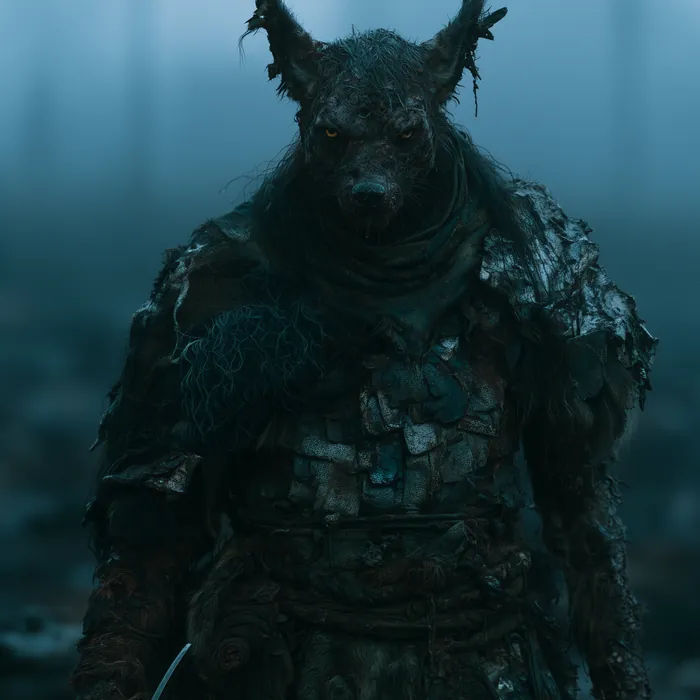
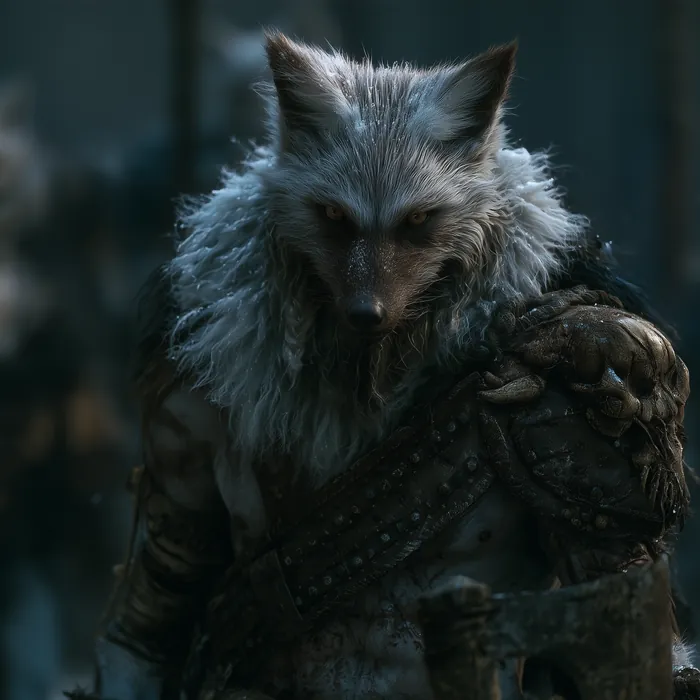
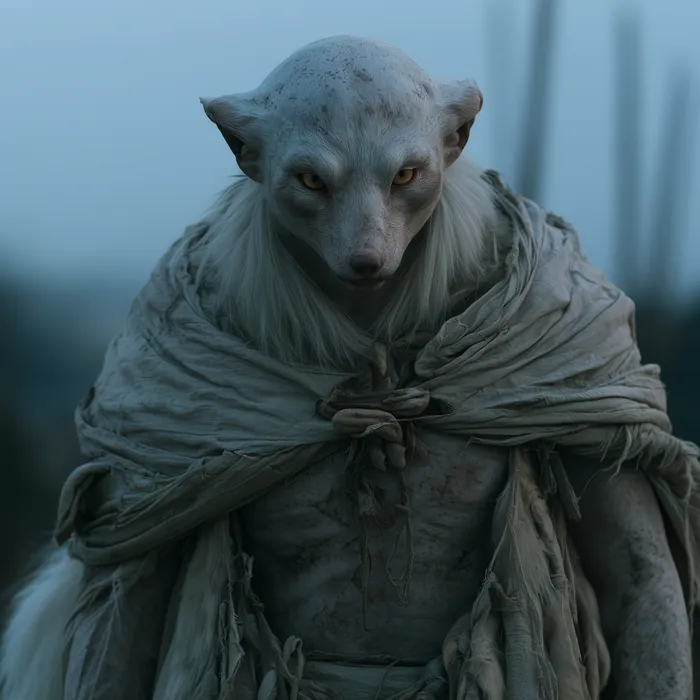
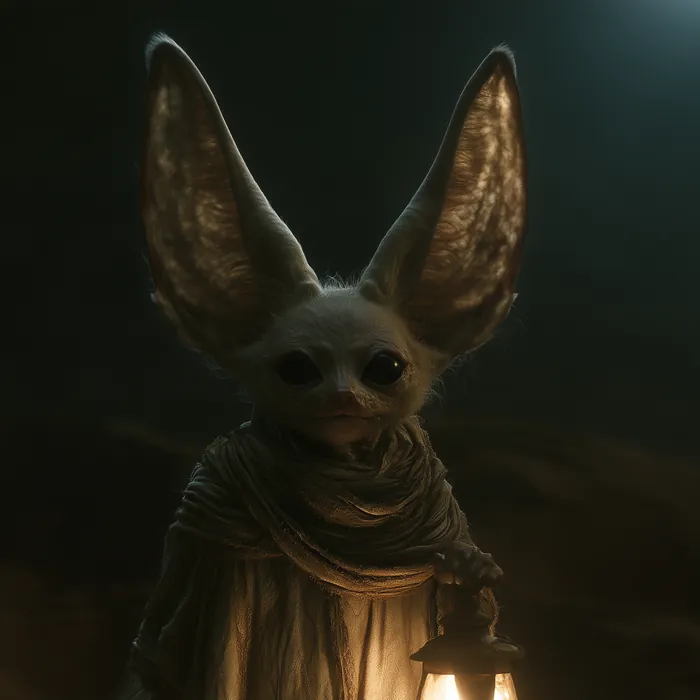
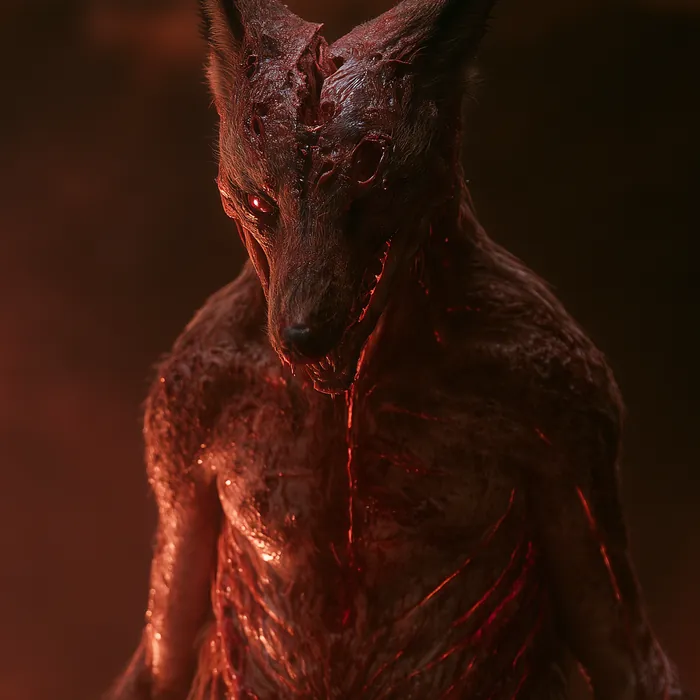
The Red Brush and its strains the base Foulen and the eight strains
Kin each has a page of its own
What divides them is the fox, or the wolf, or the jackal that went into each line, and the country that line ended up working. They do not regard one another as relatives in any warm sense, and the kin names are mostly used by other peoples and by bounty clerks.
Lore
Summary
Extended Lore
Still unwritten in the record for this entry.
- Where the great Verges lie on the map of Nu, and which forest edge districts hold them thickest
- Which counties pay the bounty on the brush, and how old the oldest standing payment is
- Whether the hearing of the horn was cut out of them by their makers or withdrawn from them by Irus
- What, if anything, answers the Foulab at the rite
- How a dead Foulen's range is auctioned at the two Nights, and who does the auctioning
- The wooded runs Argath works between the Wilder lands and the markets